Showing posts with label liver. Show all posts

Thursday, 4 April 2013

Sarvangasana


This is a mysterious Asana which gives wonderful benefits. This is termed "all-members' pose," because all the parts of the body are engaged when this Asana is performed. Sarvangasana is considered to be the 'Queen of yoga asanas', Sarvangasana (shoulder stand) is a yoga pose which involves the muscles of the entire body. It is classified as an inverted pose. Inverted poses help to tone and stretch the body by working against the force of gravity. sarvangasana is one of those poses which improve blood circulation throughout the body.There are many health benefits of practicing this pose on a regular basis.

Steps to Perform :-
Fold two or more firm blankets into rectangles measuring about 1 foot by 2 feet, and stack them one on top of the other. You can place a sticky mat over the blankets to help the upper arms stay in place while in the pose. Then lie on the blankets with your shoulders supported (and parallel to one of the longer edges) and your head on the floor. Lay your arms on the floor alongside your torso, then bend your knees and set your feet against the floor with the heels close to the sitting bones. Exhale, press your arms against the floor, and push your feet away from the floor, drawing your thighs into the front torso.

Continue to lift by curling the pelvis and then the back torso away from the floor, so that your knees come toward your face. Stretch your arms out parallel to the edge of the blanket and turn them outward so the fingers press against the floor (and the thumbs point behind you). Bend your elbows and draw them toward each other. Lay the backs of your upper arms on the blanket and spread your palms against the back of your torso. Raise your pelvis over the shoulders, so that the torso is relatively perpendicular to the floor. Walk your hands up your back (toward the floor) without letting the elbows slide too much wider than shoulder width.

Inhale and lift your bent knees toward the ceiling, bringing your thighs in line with your torso and hanging the heels down by your buttocks. Press your tailbone toward your pubis and turn the upper thighs inward slightly. Finally inhale and straighten the knees, pressing the heels up toward the ceiling. When the backs of the legs are fully lengthened, lift through the balls of the big toes so the inner legs are slightly longer than the outer.

Soften the throat and tongue. Firm the shoulder blades against the back, and move the sternum toward the chin. Your forehead should be relatively parallel to the floor, your chin perpendicular. Press the backs of your upper arms and the tops of your shoulders actively into the blanket support, and try to lift the upper spine away from the floor. Gaze softly at your chest.

As a beginning practitioner stay in the pose for about 30 seconds. Gradually add 5 to 10 seconds to your stay every day or so until you can comfortably hold the pose for 3 minutes. Then continue for 3 minutes each day for a week or two, until you feel relatively comfortable in the pose. Again gradually and 5 to 10 seconds onto your stay every day or so until you can comfortably hold the pose for 5 minutes. To come down, exhale, bend your knees into your torso again, and roll your back torso slowly and carefully onto the floor, keeping the back of your head on the floor.

benefits:-
 In this Asana, the thyroid gland is nourished properly which plays a prominent part in the metabolism, growth, nutrition and structure. Healthy thyroid means healthy function of the circulatory, respiratory, alimentary, genito-urinary and nervous systems of the body. This thyroid operates in conjunction with other ductless glands, pituitary, pineal in the brain, suprarenal above the kidneys, liver, spleen, testes. If this thyroid is diseased all the other glands suffer. A vicious circle is formed. Sarvangasana keeps a healthy thyroid. Healthy thyroid means healthy functioning of all the organs of the body.

Yogis have practising  this Asana to hundreds of persons. Yogis have started a Sirsha-Sarvanga Propaganda. Yogis generally recommend these two Asanas, combined with Paschimottanasana invariably to those who approach them. These three Asanas alone can keep you in perfect health. You need not take any long walk or physical exercise. All have unanimously reported to them of the wonderful, mysterious, beneficial results of this Asana. As soon as you come down from the Asana, it braces you up and gives a new vigorous, healthy tone. It is an ideal "pick-me-up".

It supplies a large quantity of blood to the spinal roots of nerves. It is this Asana which centralises the blood in the spinal column and nourishes beautifully. But for this Asana there is no scope for these nerve-roots to draw sufficient blood-supply. It keeps the spine quite elastic. Elasticity of the spine means everlasting youth. It prevents the bone from early ossification (hardening). So you will preserve and retain your youth for a long time. This Asana destroys the ravages of old age. It helps a lot in maintaining Brahmacharya. Like Sirshasana, it makes you an Urdhvareto-Yogi. It checks wet-dreams effectively. It acts as a powerful blood tonic and purifier. It tones the nerves. It is a cheap, readily available blood, nervine and digestive tonic. It is at your disposal at all times. It will save your doctor's bills. When you have not much time to practise a course of Asanas, do this without fail daily along with Sirshasana and Paschimottanasana. It is useful in gonorrhoea and other diseases of bladder and ovaries. It removes sterility and diseases of womb. Ladies also can practise this Asana with safety. Sarvangasana awakens Kundalini and augments the Jatharagni (digestive fire). It removes dyspepsia, constipation and other gastro-intestinal disorders of a chronic nature. It energises, invigorates and vivifies. A course of Sirsha-Sarvangasana powerfully rejuvenates.

Saturday, 9 February 2013

CINMAYA MUDRA


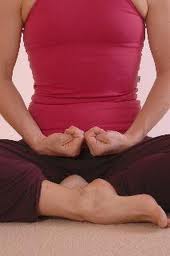
cinmayamudra is sit comfortable sitting position, with the needle upright. Place . Fingers and thumbs together and extend the other 3 fingers out. Turn the palms.Upwards, and rest the backs of the hands onto the knees or thighs. In yoga cinmaya mudras Close the eyes and breathe naturally, through the nose. Try to maintain consciousness of each. Breath moving into and out of the nostrils for two or three minutes.
   Yoga mudras, or hand gestures, are specific postures for the hands performed during yoga or meditation. Mudras can aide the body in healing by channeling energy to specific areas or parts of the body, and energizing the mind or body connection. The benefits of yoga mudras can be seen when used on a regular basis. It is often helpful to perform mudras during pranayama. Pranayama, meaning “expansion of life force, refers to yogic breathing. Pranayama might be described as deliberate and deep breathing with the goal of using the breath to bring new energy into the body to stimulate physical and mental well-being. When used in conjunction, pranayama and mudra can have powerful effects on the body and mind.
Sit or lie in a comfortable position when practicing pranayama. Mudras should be held in relaxed positions, without strain or discomfort. The Vishnu Mudra can be used to alternate breaths through each nostril. Use the right hand o perform Vishnu. Place the tips of the forefinger and middle finger at the base of the thumb while leaving the last two fingers upright. Use the thumb to close one nostril, breath deeply filling up the belly and chest, then release the breath and use the ring finger to close the opposite nostril. Continue alternating breaths.
Practice Chin Mudra to ground the mind. Place hands on the knees or thighs, palms down. Place the tip of the forefinger and the tip of the thumb together, letting the other three fingers relax. The Jnana Mudra is very similar to Chin. The fingers are placed in the same position, but the hands should rest facing up, as opposed to down. Gnana can uplift the mind, giving a sense of spaciousness.


Thursday, 7 February 2013

SALABHASANA


Salabhasana comes from Sanskrit word Salabha + asana where Salabha means locust or grasshopper. This is why; this wonderful yoga posture is also called Locust Pose. Salabhasana (Locust pose) strengthen muscle of lower back and upper leg which are the most affected part of people seating on chair for long time.

How to perform Salabhasana:-

Before you start with salabhasana, rest on stomach by making your hand as a pillow under your head.
Bring your arms under your body and try to keep your elbows as closer as possible. Refer below image for more details. Once you are into this position, inhale and lift your right leg as high as you can. Stay in this position for upto 5-30 seconds as you can continue with breathe. Now perform the same posture with your left leg.
In full locust, you need to start with the same posture as you did in half locust but the basic difference is; you have to lift both the legs.

Benefits:-

Strengthening the muscle of lower back
Strengthen the shoulder and arm
Strengthening the muscle of upper leg
Stimulates the stomach and intestines helping to relieve gastrointestinal gas and improve digestion.
Strengthens the bladder, and stretches the spine.
Apart from these, there are various mental and physical benefits of practicing Salabhasana every day.This Asana gives a posterior curvature to the spine. It bends the spine backwards. In bending the spine it serves as a counter-pose to Paschimottanasana, Halasana and Sarvangasana which bend the spine forwards (anteriorly). Like Mayurasana, it increases the intra-abdominal pressure. It supplements the Bhujangasana. Bhujangasana develops the upper half of the body, while Salabhasana develops the lower half of the body and the lower extremities also. It tones up the muscles of the abdomen, thighs and legs. It brings down the accumulated faecal matter of the stomach to ascending colon, from ascending colon to transverse colon of large intestines, from transverse colon to descending colon and from there to the rectum. Read any book on elementary physiology. It will help you a lot.

This Asana gives a good exercise for the abdomen. It relieves constipation. It tones the abdominal viscera (organs) viz., liver, pancreas, kidneys, etc. It removes several diseases of the stomach and bowels. It cures sluggishness of liver and hunchback. the lumbo-sacral bones are toned up. Lumbago is removed. All forms of myalgia of the lumbar region (hips) are removed. The digestive fire is increased. Dyspepsia is removed. You will have very good appetite.

Wednesday, 6 February 2013

BHUNJASAN


The Cobra Pose or Bhujangasana, also known as the snake pose, belongs to the category of backbends. It is one of the simpler of these poses and is in fact a basic backbends that needs to be learnt and practiced by any practitioner before moving on to advanced backbends. No matter how simplistic some postures may appear, their relevance and benefits can not be questioned as they are the product of millennia of practice and perfection. All of the poses in yoga have an important role to play and none of them are meant to be practiced as individual exercises. They are instead practiced in flowing sequences, with the practitioner moving from one posture to the next.No matter how simple or trivial a pose may seem do not discard it as being unimportant or of no relevance. The Cobra Pose yoga is of particular relevance to beginners, but it is also useful to more advanced students, because it does offer a number of health benefits and also prepares your body for the more advanced back bends. Practice of the Cobra Pose or bhujangasana yoga will help to prepare you for the leg work and pelvic movements required in back bends. It in fact works on the pelvis, legs and belly. When executed perfectly your spine will extend gracefully, with the support of your legs, while the pelvis and belly work in unison to decompress and provide support to the lower back.
Apart from the relevance of the Cobra Pose in your growth and development as a practitioner of yoga, there are also many health benefits to be derived.


Permorming the Asana:-

Bent both the elbows and location the palms on the floor by the side of the last rib bone.
Slowly lift the head and then lift the chest/ Feel the weight of the body at the lumber area.
fetch the chest and head down, touching the floor with the chin.
Release the hands and place them above the head area on the floor that is. come back to the main point.Breathe out at whatever time you bend downwards and breathe in air while coming up. normal breathing in the final position.


Benefits of Bhunjasan:-

The Cobra Pose helps to reduce both back and neck aches, and it also helps to keep your spine supple and healthy. The arching motion of the spine helps to improve circulation and blood flow in the region. The nerves along the spine are also toned, and this improves communication between your brain and the rest of your body.
The Cobra Pose also exercises some pressure on the abdominal region, and this acts in a stimulation manner, particularly for the digestive organs. It therefore helps to normalize your appetite, and relieve flatulence or constipation.
It helps improve both liver and kidney functions.
It strengthens the adrenal glands and thereby improves the balance of hormone secretions. It also enhances the functioning of the thyroid glands.
It improves breathing as it expands and stretches the chest. This very same moment also helps correct posture.
It is also therapeutic and in certain cases is part of the routine for a slipped disc and sciatica.